

Software Testing vs Development: Which Is Right for You?
Choosing the right IT career path can feel overwhelming, especially when deciding between Software Testing and Software Development.
Both are powerful career options with strong demand, high salaries, and long-term growth. But the right choice depends on your skills, personality, and future goals.
This guide serves as a comprehensive decision-making guide for IT courses, helping you understand the differences between the two roles and determine which path aligns best with your strengths. If you’re unsure about building a career in software testing or development, this blog will give you clarity.
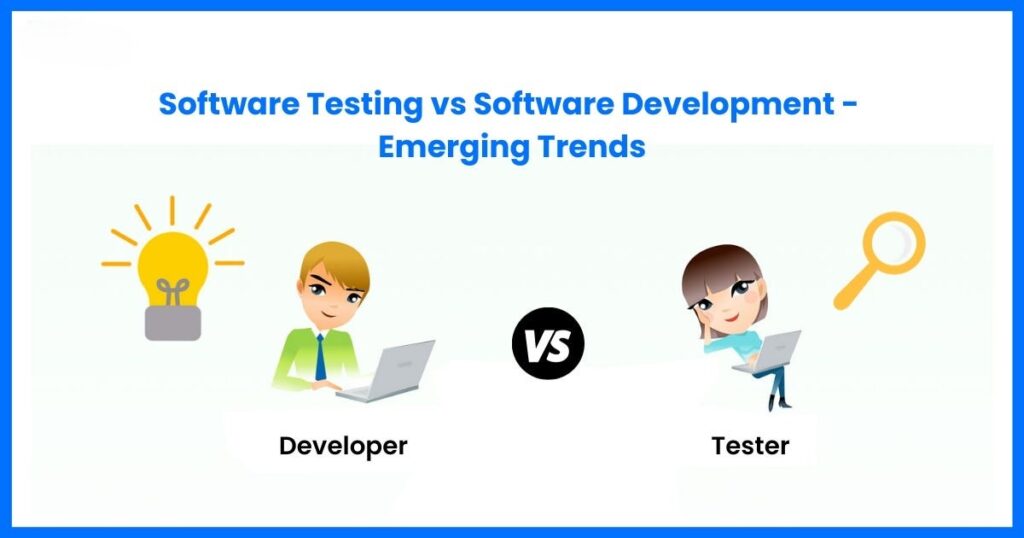
Table of Contents
What Is Software Development?
Software Development focuses on designing, coding, building, and maintaining applications. Developers transform ideas into digital products, including websites, mobile apps, enterprise systems, and automation tools.
What Developers Do
Write clean, optimised code
Build software features and applications
Fix bugs and improve performance
Work with frameworks, libraries, and APIs
Collaborate with testers, designers, and DevOps engineers
Skills Needed for Development
Logical and analytical thinking
Knowledge of programming languages (Python, Java, C#, JavaScript)
Problem-solving mindset
Understanding of databases and algorithms
Who Should Choose Development?
Choose Software Development if you:
✔ Enjoy coding and building solutions
✔ Are creative and logical
✔ Like solving problems
✔ Want to create applications from scratch
What Is Software Testing?
Software Testing involves checking whether a software product works correctly, is error-free, and meets user expectations. Testers ensure the product is stable before it reaches real users.
Types of Software Testing
Manual Testing
Automation Testing (Selenium, Java, Python)
API Testing
Performance Testing
Mobile Testing
Functional & Non-Functional Testing
Skills Needed for Testing
Attention to detail
Analytical thinking
Basic programming (only for automation)
Good documentation and reporting
Understanding of SDLC & STLC
Who Should Choose Testing?
Choose Software Testing if you:
✔ Are detail-oriented
✔ Prefer investigating how things work
✔ Want an easier entry into IT
✔ Like finding problems and improving quality
Software Testing vs Development: Key Differences
| Feature | Software Testing | Software Development |
|---|---|---|
| Primary Focus | Finding bugs & ensuring quality | Building applications & systems |
| Coding Requirement | Low–Medium | Medium–High |
| Learning Difficulty | Easier for beginners | More challenging |
| Career Entry | Faster for freshers | Competitive |
| Best For | Non-IT backgrounds & logical thinkers | Those who enjoy coding |
Career Growth & Future Scope in 2026
Software Testing Future Demand
The demand for testers is growing due to:
AI-driven test automation
Continuous integration (CI/CD)
Cloud applications
Microservices & API testing
Mobile and performance testing
Automation Testers, QA Engineers, and Performance Testers earn high salaries and have global opportunities.
Software Development Future Demand
Development is evolving with:
Full-stack development
AI & machine learning
Cloud-native applications
Mobile app development
DevOps engineering
Developers grow into roles like Senior Developer, Solution Architect, Cloud Engineer, or Technical Lead.
Both fields have a strong future, but your career interest matters most.
How to Choose Between Testing and Development?
Use this simple IT Course Decision Guide:
✔ Do you enjoy coding?
Choose Software Development
✔ Do you enjoy analysing systems and finding bugs?
Choose Software Testing
✔ Are you from a non-IT background?
Testing is easier to start with
✔ Do you like building things from nothing?
Development is perfect for you
✔ Do you prefer structured, process-driven work?
Testing suits you better
Which Career Has Better Salary?
Both offer excellent salaries, but:
Developers often start higher
Automation Testers earn equally high after gaining experience
Performance Testers and SDETs (Software Development Engineers in Test) can earn even more
Frequently Asked Questions (FAQ)
Yes. It’s beginner-friendly and suitable even for non-IT students.
Manual Testing doesn't. Automation Testing requires basic coding in Java or Python.
Development requires more coding, logic, and problem-solving, so it can be more challenging.
Yes. Many professionals start in testing and later move to development.
Testing usually has more openings for freshers, while development offers more advanced roles.
Yes. Automation skills are highly in demand globally.
Both are strong. Development has more technical growth; testing has more quality and process-based growth.
Programming languages, algorithms, problem-solving, and database knowledge.
Analytical skills, test case design, documentation, and basic programming (for automation).
Start with Software Testing to understand IT fundamentals; move to Development later if you enjoy coding.
For beginners, Software Testing offers an easier entry into IT. For professionals aiming for advanced technical roles, a developer or tester provides excellent long-term growth.