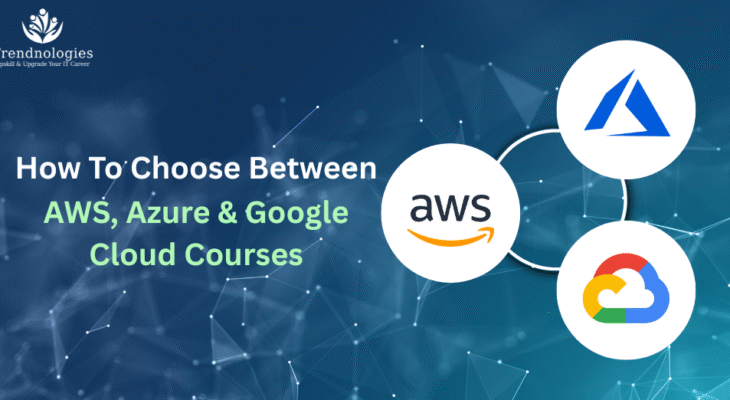

How to Choose Between AWS, Azure, and Google Cloud Courses

How To Choose BetweenAWS, Azure & Google Cloud Courses Cloud computing has transformed the IT world into a skill-driven landscape, where certifications and practical knowledge are the keys to unlocking career growth. But here’s the challenge: AWS vs Azure vs Google Cloud courses often confuse beginners and even professionals. Each platform has its strengths, unique certifications, and market demand. If you’re serious about entering the cloud domain, choosing the right learning path is crucial. In this blog, we’ll guide you through an in-depth comparison of these three giants, how their courses differ, and which one fits your career goals. Table of Contents Why Cloud Certifications Matter Today The IT industry has shifted rapidly from traditional on-premise setups to cloud-first solutions. Organizations need skilled professionals who understand not only cloud fundamentals but also advanced solutions like serverless, containers, and hybrid cloud. That’s why AWS vs Azure vs Google Cloud courses are not just certifications—they’re gateways to job opportunities, higher salaries, and global career mobility. Recruiters value candidates who can demonstrate both knowledge and hands-on project experience. Overview of AWS, Azure, and Google Cloud Before diving into their training paths, let’s look at what sets them apart. Amazon Web Services (AWS): The market leader, known for reliability, global availability, and a vast ecosystem of services. Microsoft Azure: Strong integration with Microsoft tools, making it a natural choice for enterprises already using Microsoft solutions. Google Cloud Platform (GCP): Popular for AI, machine learning, and big data applications. Understanding these distinctions helps you decide which AWS vs Azure vs Google Cloud courses align with your future career specialization. Course Structures and Certifications When you compare AWS vs Azure vs Google Cloud courses, you’ll notice each provider has a tiered structure designed for beginners, intermediates, and advanced professionals. AWS Certifications: AWS Certified Cloud Practitioner (beginner) AWS Solutions Architect – Associate (intermediate) AWS DevOps Engineer or Solutions Architect – Professional (advanced) Azure Certifications: Azure Fundamentals (AZ-900) Azure Administrator Associate (AZ-104) Azure Solutions Architect Expert (AZ-305) Google Cloud Certifications: Associate Cloud Engineer (entry level) Professional Cloud Architect Professional Data Engineer By comparing the syllabus of AWS vs Azure vs Google Cloud courses, you can choose the right foundation and gradually specialize. Job Market Demand Which course should you pick if you’re job-oriented? Here’s what the current market shows: AWS dominates the market share but faces increasing competition. Azure is highly demanded in corporate ecosystems. Google Cloud is growing rapidly, especially in startups and data-driven businesses. Thus, if you’re aiming for corporate jobs, Azure could be your priority. If you’re aiming at global startups or innovation-driven companies, Google Cloud shines. For a safe bet with the largest opportunities, AWS remains unbeatable. When comparing AWS vs Azure vs Google Cloud courses, think about where you want to work and the type of projects that excite you. Hands-On Learning is Non-Negotiable Regardless of the cloud provider you choose, theory alone won’t make you job-ready. A great course should provide: Hands-on labs. Real-time projects like setting up virtual networks, deploying apps, or configuring CI/CD pipelines. Exposure to automation tools like Docker, Kubernetes, and Terraform. This is where enrolling with the best software training institute in Chennai can make a difference. Institutes that focus on project-based learning ensure you leave with practical skills—not just certification badges. Cost Comparison of Courses Another important factor in deciding between AWS vs Azure vs Google Cloud courses is cost. AWS certifications cost around ₹8,000–₹25,000 depending on the level. Azure certifications are priced between ₹8,000–₹14,000. Google Cloud certifications typically cost ₹10,000–₹16,500. While the fees are not drastically different, you should also consider the cost of training programs and exam retakes. Some institutes provide bundled courses that reduce your investment while offering multiple platforms. Which Platform is Easier for Beginners? AWS: Easy to start with, given its vast community support. Azure: Very beginner-friendly, especially if you’re already familiar with Microsoft products. Google Cloud: Slightly more technical at the start, but extremely rewarding for those who love working with AI, ML, and data. Thus, for absolute beginners, Azure or AWS might feel smoother. But if you’re looking for a niche skill, Google Cloud is worth the challenge. Career Growth Opportunities The real goal of comparing AWS vs Azure vs Google Cloud courses is identifying which one accelerates your career. AWS: Opens opportunities across industries, from e-commerce to finance. Azure: Preferred in enterprise IT setups, government projects, and healthcare. Google Cloud: Growing in AI startups, SaaS companies, and data science roles. Strategically, many professionals even pursue multi-cloud certifications, starting with one provider and later expanding. This makes you versatile and more attractive to employers. Why Choose Guided Training Programs While self-paced online courses are widely available, structured programs give you: Personalized mentorship. Real-time doubt solving. Placement assistance. That’s why institutions like the best software training institute in Chennai stand out—they blend certification preparation with industry exposure, bridging the gap between learning and working. Final Thoughts When it comes to AWS vs Azure vs Google Cloud courses, there is no single “best” answer. Your choice should depend on your career goals, budget, and area of interest. AWS gives you the widest global scope, Azure integrates seamlessly with enterprises, and Google Cloud excels in innovation. Whichever you choose, ensure you gain hands-on practice, keep up with industry updates, and focus on solving real business problems through the cloud. FAQs on Importance of Certifications in Landing IT Jobs Faster 1. Which is better for beginners: AWS, Azure, or Google Cloud? Azure and AWS are beginner-friendly, while Google Cloud is slightly technical but excellent for data-focused learners. 2. Are AWS vs Azure vs Google Cloud courses necessary for DevOps careers? Yes, as DevOps engineers often work across multi-cloud environments, having certification in at least one provider is crucial. 3. Do cloud certifications guarantee a job? Certifications open doors but don’t guarantee jobs. Practical experience and project work matter equally.   4. Which platform pays more in the job market? AWS generally leads, but Azure and Google Cloud professionals also earn competitive salaries depending

Read More
Full-Stack Developer

Full-Stack Development vs Front-End Development: Which Pays More?

Full-Stack Developer vs Front-End Development: Which Pays More? When it comes to web development careers, the term Full-Stack Develop often sparks curiosity among IT aspirants. Many wonder whether specializing in full-stack development or front-end development offers better salary prospects and career growth. At Trendologies, we guide aspiring developers to make informed career decisions by understanding industry trends, skill demands, and real-world earning potential. Why Full-Stack Developer is in High Demand A Full-Stack Development is someone who can handle both front-end (what users see) and back-end (server-side) aspects of web applications. This versatility makes full-stack developers highly valuable in the IT industry. Companies prefer developers who can manage multiple layers of a web application, reducing costs and improving project efficiency. Key reasons full-stack developers are in demand: Ability to work on multiple technologies and frameworks Efficient handling of both client-side and server-side programming Versatility in startups and small businesses where resources are limited High adaptability in dynamic IT projects Front-End Development: Focus and Career Scope Front-end developers specialize in the user interface (UI) and user experience (UX). They focus on designing visually appealing and responsive websites using tools like HTML, CSS, JavaScript, and frameworks such as React or Angular. Why front-end development is popular: Creative work environment Direct impact on user experience Opportunities in UI/UX design and design-oriented roles Growing demand for interactive and responsive web applications While front-end developers earn well, Full-Stack Develop often have a broader skill set, which can translate into higher salaries over time. Salary Comparison: Full-Stack Developer vs Front-End Developer Salary is one of the most discussed topics among IT professionals. Here’s a rough comparison for developers in India (figures vary based on experience and location): Full-Stack Developer: ₹6,00,000 – ₹18,00,000 per year Front-End Developer: ₹4,00,000 – ₹12,00,000 per year Factors affecting salary: Experience and skillset Company size and reputation Location and demand for specific technologies Additional expertise in frameworks or cloud technologies Clearly, a Full-Stack Develop often earns more due to their wider scope of work and versatility. Advantages of Becoming a Full-Stack Developer If you’re deciding between full-stack and front-end development, here are the main advantages of choosing a Full-Stack Development path: Versatility: Can work on both front-end and back-end tasks Better job opportunities: Preferred by startups and enterprises Higher salary potential: Broader skills are rewarded Career growth: Easier transition into roles like tech lead, project manager, or CTO Independent project handling: Ability to take projects from conception to deployment Challenges of Full-Stack Development While the benefits are clear, being a Full-Stack Development comes with challenges: Need to constantly update knowledge in multiple technologies Balancing front-end creativity with back-end logic High responsibility in project execution Initial learning curve can be steep At Trendologies, we focus on providing practical Full-Stack Development training that prepares candidates for real-world challenges and maximizes earning potential. Skills Every Full-Stack Developer Should Master To excel as a Full-Stack Develop professionals should aim to master the following: Front-End: HTML, CSS, JavaScript, React, Angular, Vue.js Back-End: Node.js, Python, Java, PHP Database Management: MySQL, MongoDB, PostgreSQL Version Control: Git, GitHub API & Server Knowledge: RESTful APIs, GraphQL Soft Skills: Problem-solving, teamwork, communication Skill diversity is the key reason full-stack developers often earn more than front-end specialists. Trendologies Advantage for Full-Stack Development Training At Trendologies, we provide comprehensive full-stack development courses that cover both theory and hands-on projects. Our students gain real-world experience, preparing them to command high-paying roles in the industry. Why choose Trendologies? Experienced trainers with IT industry background Real-time project exposure Career guidance and placement support Industry-relevant curriculum With the right training, becoming a Full-Stack Development is not just a career choice — it’s an investment in future growth. Frequently Asked Questions (FAQs) 1. What is a Full-Stack Developer? A Full-Stack Developer handles both front-end and back-end aspects of web applications. 2. Does a Full-Stack Developer earn more than a front-end developer? Yes, generally due to broader skills and versatility, full-stack developers often earn higher salaries. 3. What technologies should a Full-Stack Developer learn? HTML, CSS, JavaScript, React, Node.js, Python, MySQL, MongoDB, Git, REST APIs, and more. 4.Is it difficult to become a Full-Stack Developer? It requires dedication and continuous learning, but proper training can make it manageable. 5. Can a front-end developer switch to full-stack development? Yes, with learning back-end technologies and databases, front-end developers can become full-stack developers. 6. Which is better for career growth: Full-Stack or Front-End Development? Full-Stack Development offers broader career options, including project management and leadership roles. 7. What is the average salary of a Full-Stack Developer in India? It ranges between ₹6,00,000 to ₹18,00,000 per year depending on experience and location. 8.Do Full-Stack Developers work in startups or big companies? Both. Startups value versatility, while enterprises often need full-stack skills for complex projects. 9. How long does it take to become a Full-Stack Developer? With structured training and practice, 6–12 months can provide a solid foundation. 10. Does Trendologies provide placement support for Full-Stack Developers? Yes, Trendologies offers placement guidance and industry connections for our trained candidates. Conclusion Choosing between front-end and full-stack development depends on your interest and career goals. However, a Full-Stack Develop enjoys versatility, better salary potential, and broader career growth. If you’re ready to take the next step in your IT career, Trendologies is here to guide you with hands-on Full-Stack Development training designed for real-world success. Join Trendologies today and become a skilled Full-Stack Developer ready to earn top salaries and build an impactful career! Follow us for Regular Updates & Offers

Read More

Machine Learning vs Data Science – Key Differences Explained

Machine Learning vs Data Science – Key Differences Explained In today’s data-driven world, two terms often dominate conversations in tech: Machine Learning (ML) and Data Science. While they are closely related, they are not the same. If you’re looking to build a career in the booming field of artificial intelligence and data analytics, it’s crucial to understand the differences between Machine Learning and Data Science. This blog explains what each field means, how they overlap, the key differences, and which one might be right for your career path.know more Table of Contents What is Data Science? Data Science is the study of extracting meaningful insights from raw data. It combines techniques from mathematics, statistics, computer science, and business knowledge. Data Scientists work on: Data Collection – Gathering structured and unstructured data. Data Cleaning – Removing errors, duplicates, and inconsistencies. Exploratory Data Analysis (EDA) – Understanding patterns and trends. Data Visualization – Presenting results with charts, dashboards, and graphs. Predictive Modeling – Using machine learning or statistical models to forecast outcomes. In simple terms, Data Science is about asking the right questions and finding insights from data. What is Machine Learning? Machine Learning is a specialized branch of Artificial Intelligence (AI) that allows systems to learn and improve from experience without being explicitly programmed. It’s more focused on algorithms and automation rather than data handling. Machine Learning involves: Supervised Learning – Training models using labeled data (e.g., spam vs non-spam emails). Unsupervised Learning – Finding hidden patterns in unlabeled data (e.g., customer segmentation). Reinforcement Learning – Training models using rewards and penalties (e.g., self-driving cars). Model Training & Optimization – Building and fine-tuning predictive algorithms. In short, Machine Learning is about creating intelligent systems that learn from data. Machine Learning vs Data Science – Key Differences Aspect Data Science Machine Learning Definition Extracting insights from data using statistics, tools, and business knowledge. Teaching machines to learn patterns and make predictions. Focus Data collection, cleaning, analysis, and visualization. Building algorithms and models from data. Skillset Statistics, SQL, Python, R, Data Visualization. Programming, Algorithms, Neural Networks, AI. Tools Excel, Tableau, Power BI, Pandas, NumPy. TensorFlow, PyTorch, Scikit-learn, Keras. End Goal Find insights and guide decision-making. Automate predictions and improve performance. Output Reports, dashboards, visualizations, business insights. Predictive models, recommendation systems, automation. How Do Data Science and Machine Learning Work Together? Consistency matters. Use coding platforms like: LeetCode HackerRank Codeforces GeeksforGeeks CodeChef Set a goal to solve 2–3 problems daily, covering easy, medium, and hard levels. Track patterns—you’ll notice similar types of questions repeating in interviews. Skills Required in Each Field Data Science Skills: Strong foundation in statistics and probability Knowledge of Python, R, and SQL Data wrangling and visualisation using Tableau, Power BI, Matplotlib Business domain knowledge to translate data into decisions Machine Learning Skills: Expertise in algorithms and programming Familiarity with deep learning, neural networks, and NLP Experience with ML frameworks like TensorFlow, PyTorch, Scikit-learn Problem-solving and optimization skills Career Opportunities Both Data Science and Machine Learning offer high-paying, in-demand jobs. Data Science Careers: Data Analyst Business Intelligence Analyst Data Scientist Data Engineer Machine Learning Careers: Machine Learning Engineer AI Engineer NLP Specialist Computer Vision Engineer According to industry reports, demand for Data Scientists and ML Engineers continues to grow by over 30% annually, making them future-proof career options. Which One Should You Choose? Choosing between Data Science vs Machine Learning depends on your interests: If you love analyzing data, finding insights, and visualizing results, choose Data Science. If you enjoy building smart systems, algorithms, and AI-powered solutions, go for Machine Learning. Both fields are interconnected, and many professionals start with Data Science fundamentals before specializing in Machine Learning. Final Thoughts The debate of Machine Learning vs Data Science is not about competition—it’s about collaboration. Data Science provides the raw material—cleaned, processed, and analyzed data—while Machine Learning turns that data into actionable intelligence and automation. FAQs on Machine Learning vs Data Science 1. Are Data Science and Machine Learning the same? No. Data Science focuses on data analysis, while ML is about building models to learn from data. 2. Which field is easier to start with? Data Science is more beginner-friendly since it starts with data handling and visualization. 3. Do Data Scientists need to know Machine Learning? Not always, but having ML knowledge gives Data Scientists a competitive edge 4. Which has better salary prospects? Both pay well, but Machine Learning Engineers often earn slightly higher due to specialized skills. 5. Is coding required for Data Science? Yes. Python, R, and SQL are commonly used in Data Science. 6. Which industries use Data Science? Healthcare, finance, e-commerce, marketing, and education. 7. Which industries use Machine Learning? AI, robotics, self-driving cars, recommendation systems, fraud detection. 8. Can I switch from Data Science to Machine Learning? Yes. Many professionals transition after mastering data fundamentals. 9. What certifications are useful? Data Science: Google Data Analytics, IBM Data Science. Machine Learning: AWS ML Certification, TensorFlow Developer. 10. Which has more future scope? Both are essential, but Machine Learning is the driving force behind AI innovations, while Data Science powers business intelligence. If you’re looking to start a career in tech, begin with Data Science basics and then branch into Machine Learning as you grow. Together, these fields are shaping the future of technology, business, and innovation. Follow us for Regular Updates & Offers

Read More

Register Your Demo Slot

    Quick Enquiry


      Register to Achieve Your Dream Career


        Wait!! Don't skip your Dream Career

        Enroll Today & Start Your Learning Journey

          Get in Touch with us


            5 + 6 =