Non-IT to IT Career Transition: 2027 Roadmap
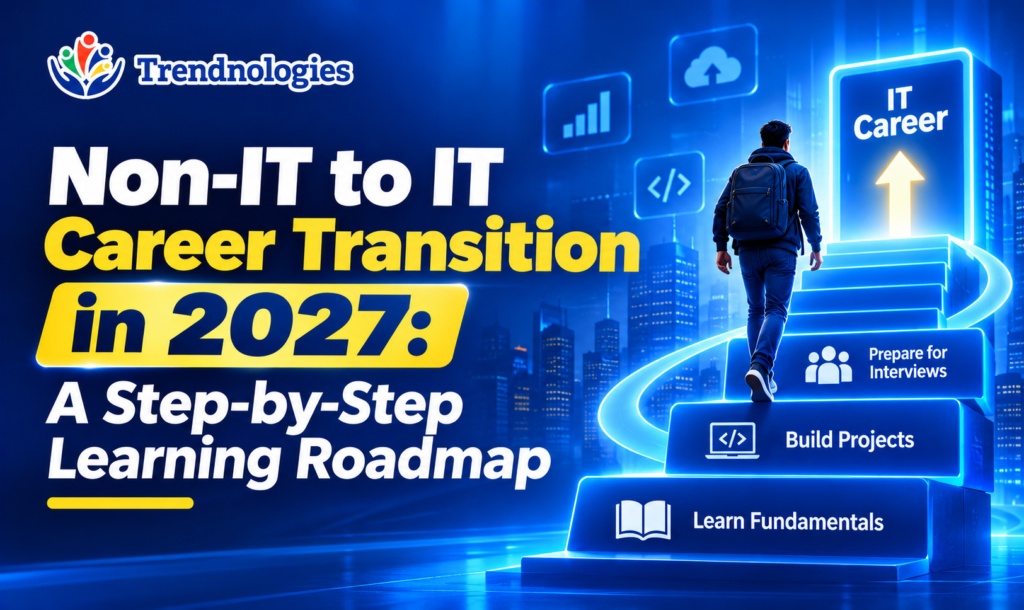
Yes, a non-IT graduate can enter the IT industry. Roles such as data analyst, software tester and junior data engineer can be learned from scratch with a structured plan and steady practice.
This guide covers the full Non-IT to IT career transition: choosing a path, picking a course, building fundamentals, creating projects and preparing for interviews.
Can a Non-IT Graduate Enter the IT Industry?
Yes. IT employers hire for skills they can see in your work, not only for the degree on your certificate. A B.A., B.Com or B.Sc graduate who can write SQL queries, automate a test or build a small data project has a real case in an interview.
Key takeaway: Your degree starts the conversation. Your demonstrated skills decide how it ends.
This applies to arts and science graduates, commerce graduates, working professionals and candidates returning after a career break. Expect several months of regular practice, and remember that results depend on your effort, your background and the hiring market.
Technical Skills vs Non-Technical Skills
Technical skills are the tools and methods you use on the job, such as SQL, Python or a test automation framework.
Non-technical skills are how you think, communicate and work with others.
● Technical to build: computer and command-line basics, SQL, one programming language, Git and the tools of your chosen path.
● Non-technical you may already have: clear communication, attention to detail, problem solving and domain knowledge from finance, retail, education or healthcare.
Key takeaway: Treat your earlier career as an asset. A former accountant who learns analytics brings context many fresh graduates lack.
Understanding Different IT Career Paths
Choose a path before you choose a course. These are the most approachable entry points for career switchers:
● Data analyst: cleans and interprets data using SQL, Excel, Power BI or Tableau.
● QA automation engineer: tests software, first manually and then with tools such as Playwright or Selenium.
● Data engineer: builds pipelines that move and prepare data using SQL, Python and cloud tools.
● Gen AI applications developer: builds apps on large language models using Python and frameworks such as LangChain.
● Software developer: writes application code in Java, Python or JavaScript. This has the steepest early curve.
Match the path to what you enjoy. If you like spotting errors, try testing. If you like patterns in numbers, try analytics. Salaries vary by city, company and experience, so check a current salary source before setting expectations.
Which Courses Are Suitable for Beginners?
A suitable beginner course starts from fundamentals, includes hands-on practice and ends with a project. These programs map to the paths above:
● Analytics: Data Analytics Training is a gentle start if you are anxious about coding.
● Automation testing: Playwright Training suits people who enjoy testing. Learn manual testing concepts first.
● Data engineering: an AI Data Engineering course builds on SQL, Python and cloud tools.
● Generative AI: Gen AI Training covers LLMs and prompt engineering. Basic Python helps.
To compare options side by side, browse the full list of software courses in Chennai and shortlist two paths.
Key takeaway: Pick one path and one primary course. Learning four technologies at once usually means finishing none.
Do You Need Coding Knowledge?
No, you do not need coding knowledge to begin. You do need to learn it gradually, and how much depends on the role.
● Light: data analytics (mostly SQL and a visual tool) and manual testing.
● Moderate: automation testing, data engineering and Gen AI work.
● Heavy: software development.
If coding worries you, start with SQL. It reads close to plain English and gives quick results. Then add Python in small steps.
A Realistic Six-Month Learning Roadmap
This plan assumes 10 to 15 hours of study a week. Adjust it to your schedule.
● Month 1, foundations and direction: learn how software is built (front end, back end, database, SDLC). Sample two paths through free tutorials or a demo class. Set up GitHub. Choose your primary path by week four.
● Month 2, core skills: learn SQL (SELECT, WHERE, GROUP BY, JOINs) on a sample database. Start Python or JavaScript and solve one small problem daily.
● Month 3, path-specific tools: analysts build dashboards in Power BI or Tableau. Testers write first Playwright scripts. Data engineers build a simple ETL pipeline. Gen AI learners call an LLM from Python.
● Month 4, projects: build two small projects and one larger one. Publish each on GitHub with a clear README.
● Month 5, resume and mock interviews: polish your projects, write your resume, update LinkedIn and start practising interview answers aloud.
● Month 6, capstone and applications: finish a capstone, apply in small weekly batches, track every application and study the questions you missed.
Resource categories: instructor-led training, official documentation (Python, SQL, Playwright, Power BI), SQL and coding practice platforms, public datasets and study communities.
Key takeaway: Courses give you knowledge. Projects give you proof.
Building Practical Projects
A practical project is a small, finished piece of work that shows you can apply a skill to a real problem. Hiring managers often check projects first because they are easier to judge than a skills list.
● Choose a real problem you understand, such as a budget or a local shop’s sales.
● Define the output: a dashboard, a test suite or a chatbot.
● Use public or self-made data.
● Build in stages. Get a basic version working first.
● Document it with the problem, tools, steps and lessons learned.
● Publish it on GitHub with screenshots.
● Capstone ideas: a sales dashboard with five SQL-backed insights (analyst), an automated test suite for a public demo shop (QA), an API-to-database pipeline (data engineer) or a document Q&A chatbot (Gen AI).
Resume Preparation and Interview Practice
Resume:
● Open with a short summary naming your target role and core tools.
● Put Skills and Projects above older work history.
● Describe each project in two or three lines: problem, tools, outcome.
● Reframe past work as transferable value, such as “managed weekly reports for 200 accounts”.
● Include GitHub and LinkedIn links.
Interview practice
● Revise SQL, your programming language and the core concepts of your path.
● Prepare a two-minute answer on why you are moving into IT.
● Be ready to explain every decision in your projects.
● Run mock interviews with a mentor or trainer. Review role-specific questions on the interview questions page.
Common Mistakes During a Non-IT to IT Career Transition
● Learning too many tools at once. Depth in one path beats shallow knowledge of five.
● Watching tutorials without practising.
● Skipping fundamentals such as SQL and basic programming.
● Hiding your earlier career. It is a selling point.
● Choosing a course only by price or hype.
● Waiting to feel ready. Apply once you have two or three solid projects.
● Neglecting communication practice. Knowing the answer is not enough if you cannot explain it.
How to Choose a Suitable Training Program
Use this checklist when comparing programs:
● Starting level: does the syllabus begin with fundamentals?
● Hands-on practice: are there live exercises and real-time projects?
● Trainers: do they have experience in the actual technology?
● Current syllabus: compare it with recent job postings for your target role.
● Career support: look for resume guidance, mock interviews and placement assistance, and ask exactly what that includes. This matters if you are searching for software courses with placement in Chennai.
● Trial: attend a demo class to judge the teaching style.
● Location and mode: check classroom and online options and batch timings.
At Trendnologies, learners can train at Trendnologies Chennai centres (Anna Nagar, Porur, Medavakkam and OMR). If you are comparing a software training institute in Chennai with an IT training institute in Coimbatore and the best software training institute in Bangalore, apply the same checklist to each. Write down your answers so the decision stays practical.
Frequently Asked Questions
1. Can I switch to IT without a computer science degree?
Yes. Many entry-level roles do not require one. Employers look for relevant skills, projects and clear communication.
2. How long does a non-IT to IT career transition take?
A focused plan of about six months can cover fundamentals and a few projects. The real timeline depends on weekly study hours, your starting point and your chosen path.
3. Which IT course is best for a non-IT beginner?
Data analytics and testing are common starting points because the early learning curve is gentler. The best course matches your interests and includes hands-on practice.
4. Can I return to IT after a career break?
Yes. Refresh your fundamentals, build one or two current projects and be honest about the break. A recent project reassures employers more than a long explanation.
Take the Next Step in Your Non-IT to IT Career Transition
You now have a path: choose a role, learn the fundamentals, build projects, prepare your resume and practise interviews. Next, choose the training that supports it.
Explore the Software Courses page at Trendnologies to compare programs, or talk to our team for guidance on where to begin.